Let’s Sue the Bastards
A dispatch from the desk of Pathos Romaniac
A strange legal memo crossed Pathos Romaniac’s desk suggesting something radical: instead of waiting for the political system to fix itself, citizens might start using the courts to force transparency. History suggests it wouldn’t be the first time.
Hello Thinking Americans,
A curious document landed on my desk the other day. Not smuggled in a briefcase or slid under the door in the dead of night—nothing so cinematic—but still strange enough to make me sit up, pour another cup of coffee, and read it twice.
The title alone had the personality of a granite courthouse:
A Coordinated Civil Accountability Initiative to Restore Constitutional Legitimacy.
That’s the sort of phrase that makes ordinary citizens’ eyes glaze over and lawyers reach for their reading glasses. But if you strip off the legal starch and translate it into kitchen-table English, the idea becomes remarkably simple.
What it means—for you and me, and anyone else who still believes the Constitution wasn’t meant to be a decorative artifact—is this:
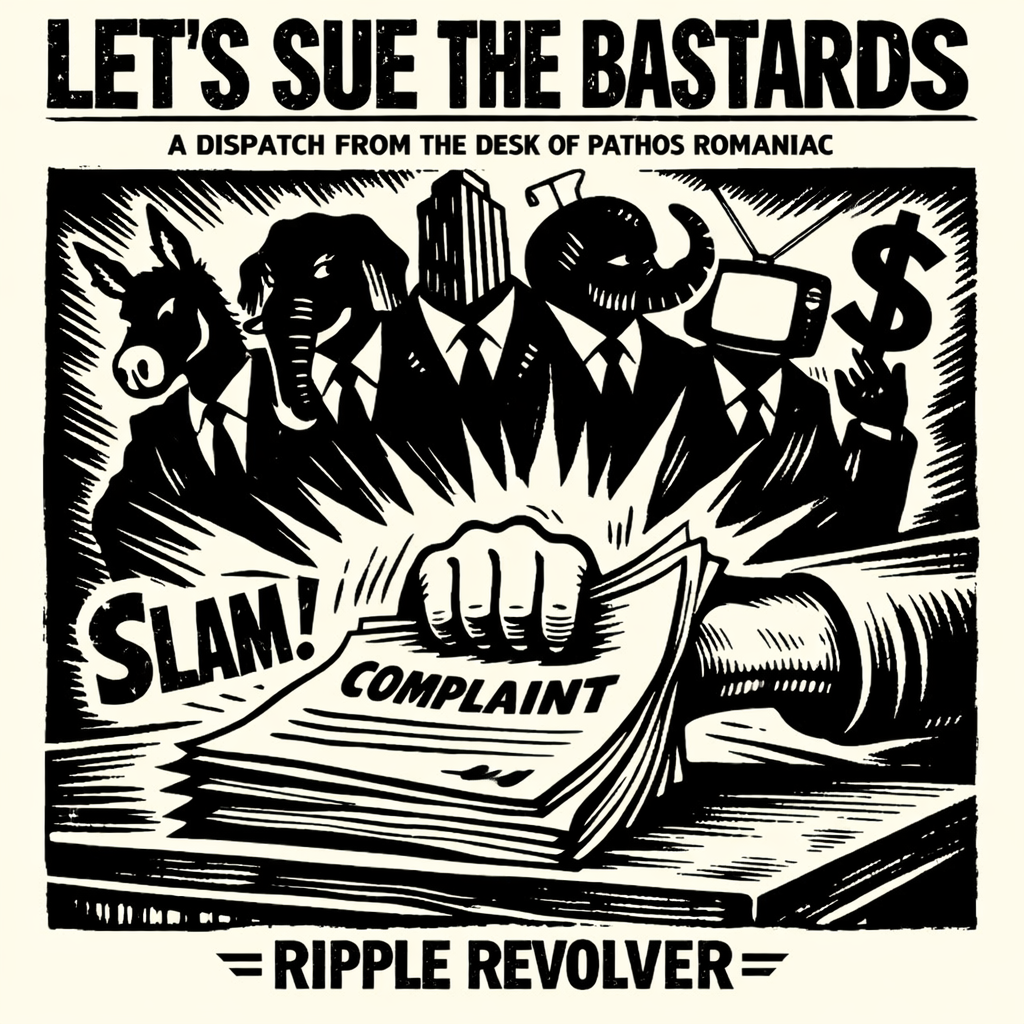
We sue the bastards.
Not metaphorically. Not rhetorically. Literally.
Now before you clutch your pearls or laugh it off as another column from the Department of Wishful Thinking, let’s pause and remember something the American public seems to forget every generation or so:
Some of the most important victories in this country didn’t come from elections.
They came from citizens dragging powerful institutions into court and forcing them—sometimes kicking and screaming—to obey the law.
Take Brown v. Board of Education.
For decades after the Civil War, segregation wasn’t just tolerated—it was baked into the legal machinery of the country. Schools were separated by race, justified by a doctrine that claimed “separate but equal.” Everyone knew the second half of that phrase was a lie, but lies have a way of surviving when they are convenient to power.
So what happened?
Citizens sued.
Not once. Not twice. Again and again, case after case, until finally the question reached the highest court in the land and the doctrine collapsed under the weight of its own hypocrisy. The point here isn’t nostalgia. It’s precedent. The courts are not merely places where politicians argue with each other. They are arenas where ordinary people can force the system to explain itself.
Another example arrived during the fever dream known as Watergate. When a sitting president tried to hide evidence of wrongdoing, the matter didn’t resolve itself through polite conversation in the Oval Office. It ended up before the judiciary in a case known as United States v. Nixon. The ruling forced the release of the tapes that ultimately destroyed a presidency. Again—citizens, journalists, and institutions used the courts to compel accountability.
Even the press itself has had to fight for that right. When the government attempted to suppress classified documents exposing the lies behind the Vietnam War, the issue landed in the courts as the Pentagon Papers case. The result reaffirmed something fundamental: the government does not get to decide which truths the public is allowed to see.
History, in other words, contains a recurring lesson that Americans periodically forget:
When power goes feral, the courtroom becomes a leash.
Which brings us back to the strange memo on my desk.
The premise of this proposed initiative is not particularly radical, though you might think so if you spend too much time watching cable news. The memo argues that the United States is experiencing a crisis of legitimacy—not merely a crisis of politics, but a crisis of trust.
And it’s hard to argue with that.
Poll after poll shows public confidence in Congress scraping the bottom of the barrel. Faith in institutions is collapsing. Citizens look at Washington and see a closed ecosystem where politicians, corporate donors, lobbyists, and media empires circulate power among themselves like gamblers passing chips around a casino table. Both parties accuse each other of corruption while quietly cashing checks from the same donor class. Meanwhile the public is told to behave, vote every few years, and hope the machinery somehow corrects itself.
Hope, unfortunately, is not a legal strategy.
The idea outlined in the memo proposes something far more practical: instead of waiting for the system to fix itself, citizens begin using the existing legal framework to force transparency.
Not a single grand lawsuit. That would be naïve. Rather, a coordinated series of civil actions—targeted, disciplined, and grounded in existing law—designed to pry open the machinery and see what’s actually happening inside.
Election law.
Antitrust law.
Campaign finance law.
Civil conspiracy statutes and, where patterns of coordinated misconduct emerge, even the possibility of racketeering claims under RICO. Administrative challenges to regulatory capture and agency capture. None of these tools are exotic. They are already embedded in the legal architecture of the country. They simply aren’t being used aggressively enough. If this strategy sounds familiar, it should. It’s the same basic playbook that consumer advocates, civil rights lawyers, and investigative journalists have used for decades.
It also happens to resemble a tactic that certain modern political figures have used to great effect—though usually for less noble purposes. If you want to understand how litigation can shape reality, look at the methods pioneered by Roy Cohn and adopted enthusiastically by his most famous apprentice, Donald Trump. Threaten lawsuits. File lawsuits. Use the legal system not merely as a venue for justice but as a lever of pressure.
Businesses fold.
Media outlets retreat.
Opponents spend their time and money defending themselves instead of advancing their agenda. The tactic works because lawsuits create gravity. They force institutions to respond. For decades that gravity has largely been applied downward—against journalists, activists, and ordinary citizens.
The question raised by the memo is disarmingly simple:
What happens if the public starts applying that pressure upward instead?
What happens when lawmakers, regulators, and the corporate networks surrounding them are required—under oath, through discovery, in open court—to explain how decisions are actually made? Maybe nothing dramatic happens. Or maybe quite a lot happens. Discovery has a funny habit of turning whispers into documents and rumors into exhibits. The mere existence of litigation can force disclosures that would otherwise remain buried in filing cabinets and encrypted inboxes. It can reveal conflicts of interest, financial entanglements, and policy decisions that look rather different when examined under the light of sworn testimony.
The goal here isn’t theatrical revolution. It’s documentation.
Build a public record.
Let the facts speak.
“If you want to understand how litigation can shape reality, look at the methods pioneered by Roy Cohn and adopted enthusiastically by his most famous apprentice, Donald Trump.
Threaten lawsuits. File lawsuits. Use the legal system not merely as a venue for justice but as a lever of pressure.”
If the system is functioning honestly, the evidence will confirm that. If it isn’t—well, that becomes harder to ignore. And yes, some names may inevitably surface along the way. Senators whose stock portfolios seem to outperform the market with uncanny precision. Legislators whose voting patterns align suspiciously well with the interests of certain industries or foreign allies. Political figures who appear less like representatives of their constituents and more like well-compensated consultants for whoever happens to be writing the checks.
None of this requires wild conspiracy theories to illustrate. The relationships are often visible in plain daylight. When enormous political donations flow from figures like Elon Musk to candidates such as Donald Trump, or when venture capitalists like Peter Thiel become major backers of politicians such as J. D. Vance, the relationships themselves are not secret. They are reported openly. The public question isn’t whether such alliances exist — they obviously do. The question is whether those relationships shape public policy in ways the public never gets to examine under oath.
But the focus of the initiative isn’t a hit list. It’s the structure itself.
The ecosystem.
The quiet agreements between power centers that operate just outside the public’s field of vision. For too long Americans have been told that accountability must arrive through elections alone. Yet elections cannot investigate financial networks. Elections cannot subpoena documents. Elections cannot compel sworn testimony. Courts can. And when used responsibly, they can do something even more important: they can create a durable record that outlives the news cycle.
Which brings us to the inevitable question.
Will this work?
I have no idea.
The machinery of power is notoriously resistant to inspection, and institutions rarely volunteer for uncomfortable scrutiny. It’s entirely possible that such an effort would encounter procedural roadblocks, hostile rulings, and enough legal jargon to wallpaper the Library of Congress. But here’s the uncomfortable truth: doing nothing has produced the system we currently inhabit.
A government increasingly insulated from its citizens.
A political class that appears to operate under different rules than the rest of us.
And a public that oscillates between apathy and rage because it no longer believes the mechanisms of accountability are functioning.
Maybe lawsuits won’t fix that. But they might illuminate it. And illumination, historically speaking, has a way of changing the trajectory of nations. So consider this an invitation rather than a proclamation. Someone out there has begun drafting a serious legal proposal—an effort to explore whether the tools of civil law can be used to reassert a principle Americans claim to cherish:
That no individual, party, or institution stands above the law.
Curious?
Take a look at the working memo yourself. Read it. Argue with it. Share it with someone smarter than me. Here’s the link:
And if the idea resonates, start talking about it. Because sometimes the first step toward restoring accountability is simply remembering that the courts exist for more than protecting the powerful. Sometimes they exist for the rest of us. And if that’s true, then perhaps it’s time we used them.
In other words:
The courts are still there.
The laws still on the books.
Let’s sue the bastards.
My name is Pathos Romaniac.
I approved this message.
A Coordinated Civil Accountability Initiative to Restore Constitutional Legitimacy
Purpose
This memo outlines a proposed public-interest legal initiative aimed at determining, through lawful civil process and evidentiary discovery, whether systemic misconduct has occurred among federal elected officials of both major political parties and their affiliated corporate, financial, media, and lobbying entities. The objective is not partisan advantage or electoral intervention, but the restoration of public trust in constitutional governance through enforceable accountability mechanisms already provided under U.S. law.