

The Comfort Culture Dilemma
Bridge The Generation
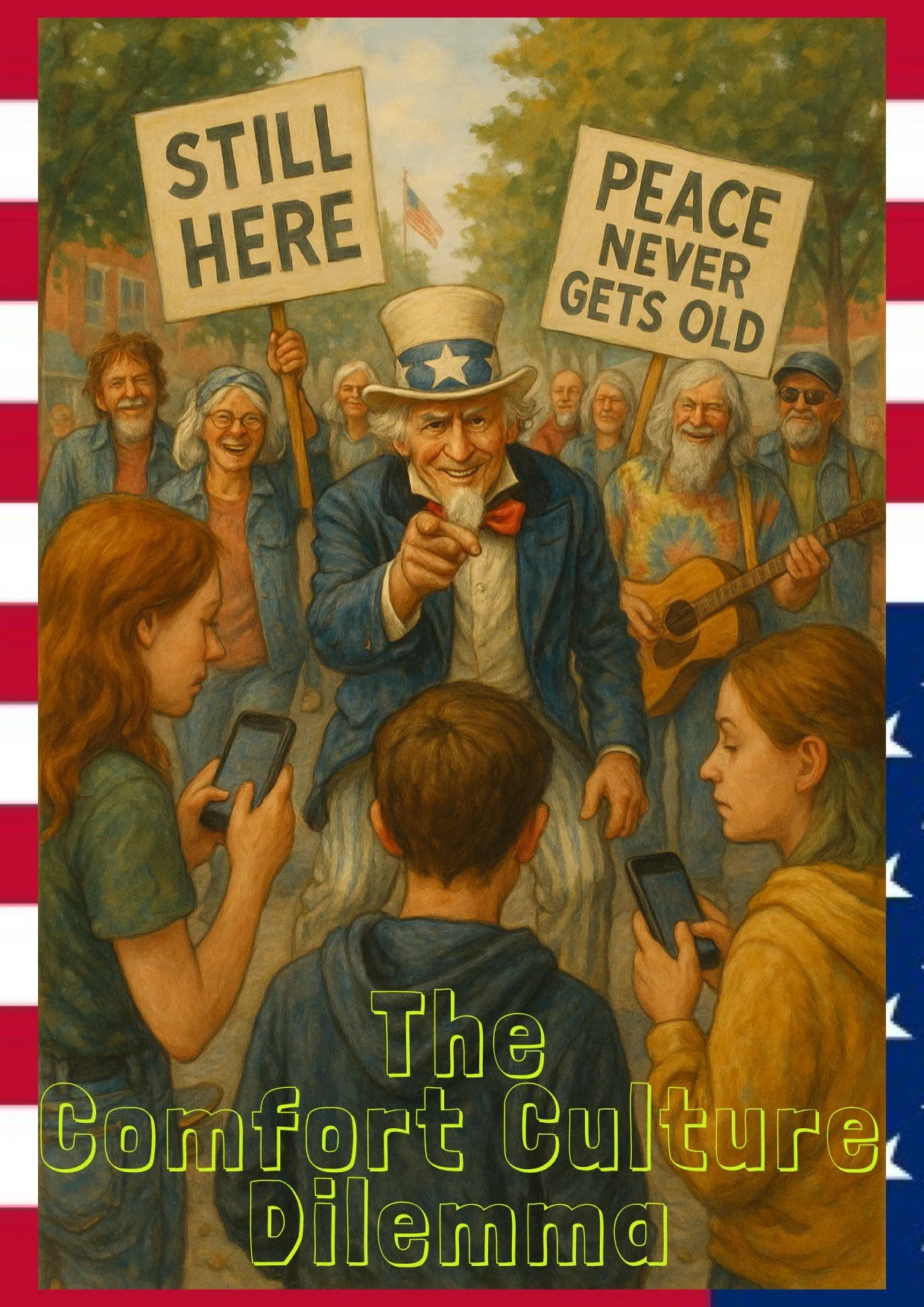
When Stephen Miller mocked recent protests as the work of “90-year-old hippies,” the barb stung because it wasn’t entirely wrong. Look around at demonstrations today—especially in places like Nevada County—and it’s clear the majority of faces belong to the gray-haired veterans of earlier struggles. People in their fifties, sixties, seventies still showing up with signs and voices raised. For me, that continuity stretches back to 1978, when I was just seventeen and arrested at the Zion Nuclear Plant protest. That same year, I helped stage an Earth Day action pushing for recycling to be included in local waste disposal long before it was a mainstream concern. Those early fights weren’t abstract lessons—they were formative experiences, a baptism into the reality that protest required bodies, not just beliefs.
Millennials, Gen Z, and now the Alphas have grown up in a different atmosphere. Their coming-of-age years were shaped by the perpetual wars launched after 9/11, wars justified by lies and sustained by fear. I took my own kids to march against the Patriot Act and the invasion of Iraq, to show them that resistance mattered—but most parents didn’t. They shielded their children, whispered politics after bedtime, and left them without the muscle memory of dissent. At the same time, the economy was tilting on sand: housing bubbles, junk loans, corporate consolidation, the creeping shadow of Wall Street long before Citizens United formalized it. And just as politics was becoming more toxic, the technology meant to democratize communication—the internet we all paid for—was being sold back to us at a premium. Social media and smartphones turned rebellion into performance.
That’s the generational divide: protest once meant risk—clubs cracking skulls, four students killed at Kent State, civil rights leaders assassinated, John Lennon nearly deported because J. Edgar Hoover saw him as a threat. Today’s protest too often feels like WWE wrestling: an arena built for spectacle, performers in costume, a choreographed fight where nobody really bleeds and everyone chuckles afterward. Our generation learned that power responds with violence when it’s truly challenged. Theirs has been trained to see rebellion as a show, a feed, a brand.
For many in the younger generations, the way they were raised narrowed their sense of autonomy from the start. Helicopter parents hovered, tracking their children’s every move, arranging supervised playdates, limiting how far they could roam. Even phones—first sold as tools of safety—became digital leashes, ways to monitor and tether rather than empower. Freedom to explore, to get lost, to scrape a knee or stumble into trouble, was replaced by a safety-first culture where adults were always in earshot. The lessons were clear: stay where it’s safe, stay where someone can see you, don’t take risks.
And it wasn’t just at home. The schools they attended reinforced the same message. Advancement wasn’t tied to merit or readiness but to age—everyone pushed along the conveyor belt whether they could handle the material or not. Critical thinking gave way to standardized testing, obedience, and quiet compliance. Early jobs carried the same pattern. Movie theaters, fast food joints, mall kiosks—places where teenagers got their first paychecks—were strict about staying in your lane. Initiative was punished; obedience was rewarded. A kid who helped an old man to his car could be written up, even fired, for abandoning his post. Compassion was a liability. The net effect was a generation trained not to question, not to improvise, but to do what they were told.
By the time these kids came of age, the culture around them had shifted in ways that reinforced the same lessons. The rise of the gig economy—Uber, DoorDash, TaskRabbit—replaced steady jobs with atomized hustle. No unions, no health insurance, no safety net, just the illusion of independence masking a deeper precarity. Work became another arena where initiative was swallowed by compliance, where everyone was their own brand but nobody had real security. A generation that had already been taught to accept surveillance and limits at home and school now found themselves stepping into an economy designed to keep them docile, disposable, and endlessly trackable through the phones in their hands.
Even with all the conditioning and constraints, the spark hasn’t gone out completely. Young people have stepped up and reshaped the national conversation, even if only for moments at a time. Hashtags like #MeToo pulled buried stories of sexual harassment into the light and gave younger workers a language for defiance. #BlackLivesMatter turned police killings into a national reckoning, driven in no small part by youth in Ferguson and beyond. After the Parkland shooting, #NeverAgain and #MarchForOurLives saw teenagers dragging television cameras and politicians into their orbit, refusing to be quiet. Climate activists, led by Greta Thunberg and amplified under #FridaysForFuture and #ClimateStrike, made climate inaction politically untenable in many countries. Native youth at Standing Rock rallied the world with #NoDAPL, livestreaming resistance and solidarity in real time. These weren’t minor blips—they were powerful, visible eruptions. But each one, no matter how forceful, was tied to a singular issue.
The problem is that every one of those sparks was mediated through systems owned and controlled by billionaires. Platforms like Facebook, Twitter, TikTok, and Instagram hold the keys to the arena, and they are not neutral referees. They shape what trends, what lingers, what disappears. Algorithms decide which voices rise and which sink. Movements may generate their own content, but the gatekeepers do the editing. And when a protest grows too visible, too disruptive to their interests or their political allies, the plug can be pulled with frightening speed. What looks like a megaphone is also a leash, and what feels like a digital commons is actually a company store.
That’s why every successful eruption so far has been tolerated—because it stayed confined to an issue. #MeToo, #BLM, #ClimateStrike—all powerful, all vital—but none of them fundamentally threatened the billionaires running the system itself. When the talk shifts from single-issue justice to systemic power—workers over billionaires, general strikes, coordinated tax resistance—when the targets become not just police departments or predatory bosses but the platforms and financiers themselves—that’s when the feed goes dark. The moment protest turns its eyes toward the gatekeepers, the gates slam shut.
The worst of it isn’t just the convenience—it’s the way it’s hollowed out our connections. Four friends at dinner, each staring into a different screen, laughing at different memes, lost in different rabbit holes. Couples who’ve shared decades together sit side by side, not to watch the sunset or remember where they’ve been, but to scroll in silence. And those rabbit holes don’t just isolate—they divide. They teach suspicion, fear, contempt: don’t talk to gay people, they’ll convert you; don’t talk to immigrants, they’re stealing your jobs; don’t talk to the neighbor with a different yard sign, they’re the enemy. Bit by bit, we’ve traded human conversation for curated feeds, and the result is a culture where people don’t even talk to each other anymore. So it isn’t just the kids, and it isn’t just the “90-year-old hippies.” It’s every single one of us. All of us.
And the question that hangs in the air is simple: how do we change that?
We start by showing up—in the real world, not just the virtual one. We bring the protest off the timeline and back into the town square. We build the bonfire again, and this time, we make sure the whole village is invited.
Imagine a Battle of the Bands where teenage punks trade sets with silver-haired rockers, where amps crackle and generations cheer for each other. Picture an ArtFest under the oaks—chalk, clay, crayons, paint—where toddlers smear color beside old-timers who remember smearing slogans across protest signs in ‘68. Or a Repair Café where a young woman fixes a busted toaster while listening to the story of how her neighbor once fixed elections with his vote. Pair that with a StorySwap—one memory shared for every tool repaired. The truth is, we don’t need another app to connect us. We need eye contact. We need rituals. We need each other.
So we host Dead Zones—spaces without screens, where people come not to scroll but to speak. We dance at costume balls dressed as American heroes who stood for something real. We run 5Ks for the future, not to beat the clock but to remember we still have time. And most importantly, we stop asking who’s too old or too young to matter and start asking who’s willing to risk showing up.
Change doesn’t come from scrolling. It comes from sitting next to someone you’ve never met and asking, “What do you remember? What do you hope for?” It comes from laughter between generations, from meals shared without distraction, from music played live and loud. Change is the moment when someone realizes they’re no longer alone—and that they never were.
So we print the flyers. We hand out the handbills. We write invitations in our own handwriting. We ask the kids to come, and we ask the elders to listen. And then we flip it—we ask the elders to come, and the kids to teach us what we’ve forgotten. That’s the loop. That’s the bridge.