

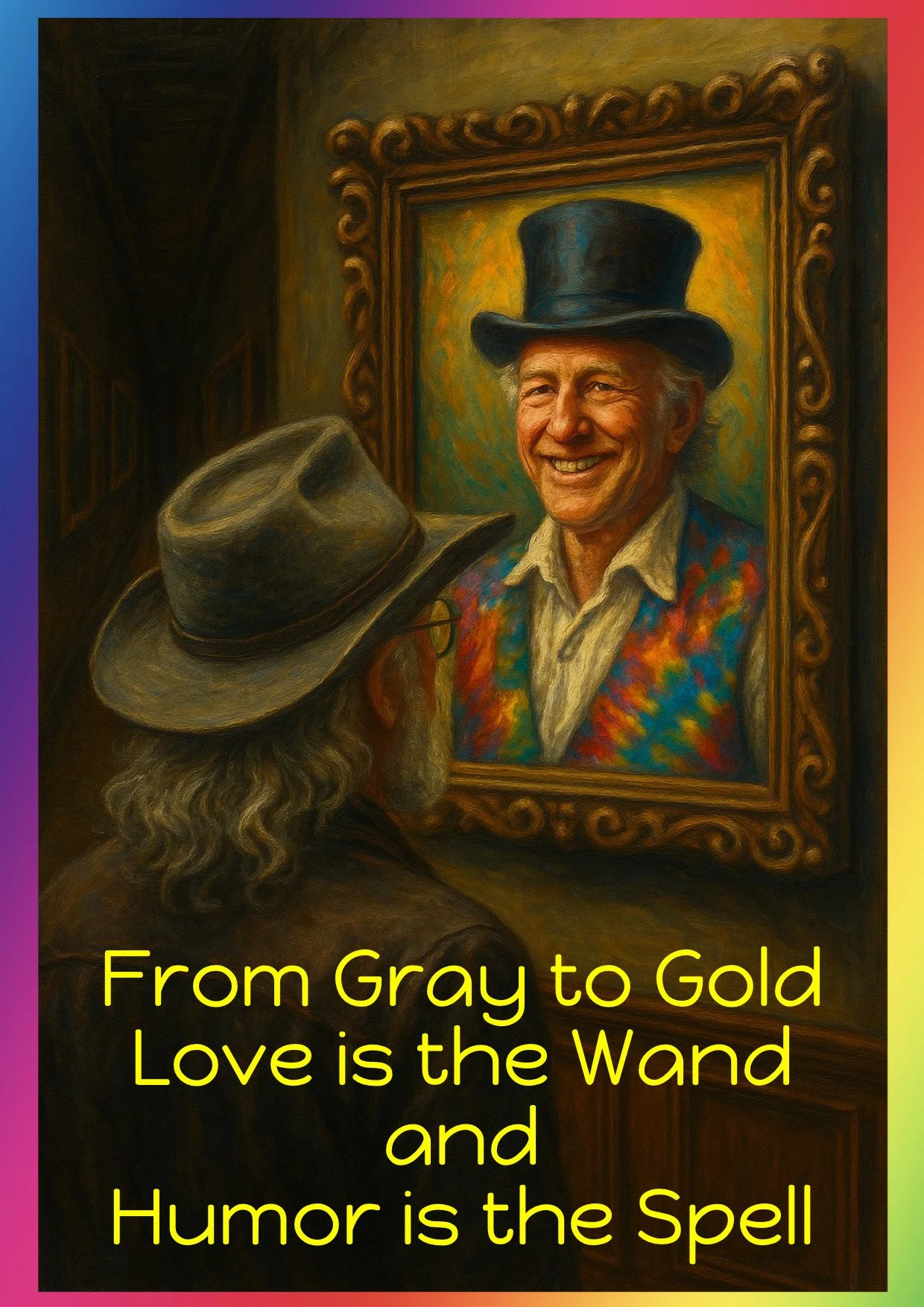
From Gray to Gold
Love is the Wand and Humor is the Spell
The first exhibition, “From Gray to Gold; Love is the Wand and Humor is the Spell” is one of the most significant, and one of the first to be honored in my Hall of Heroes.
Monday, the 10th day of November, marked a somber and yet, beautiful melody of memories for me. In 2001, on November 10th, the world was diminished by the loss of Kenneth Elton Kesey. Most people probably don’t know who he was, but there are many who did know his work. The people who do know who he was are often impressed, and those of us who have met him are incredibly fortunate. Ah, but those who worked with him, those who loved him and who he loved, they are truly blessed.
How I First Discovered Kesey
It began, as so many awakenings do, in a dark room filled with flickering light. My mother and I had a ritual—a small mercy between paycheck weeks—our Sunday movie date at the Willow Creek Theater in Palatine. Popcorn for her, Milk Duds for me, and whatever story was cheap enough to make the cut. That day in February 1972, the marquee read Sometimes a Great Notion.
On the screen, Paul Newman fought a river, a storm, and a union, but what I saw was something deeper: defiance with dignity. “Never give an inch,” Newman’s voice said, and something in that line burrowed into my bones. When the credits rolled and I saw the name Ken Kesey, it was like spotting the name of a prophet.
So I did what a ten-year-old seeker does—I rode my Schwinn to the Arlington Heights Library, cheeks red from the cold, and asked the librarian for Sometimes a Great Notion. She looked surprised, as if a child had just ordered whiskey neat, but she fetched it for me. Ten days later, I came back for One Flew Over the Cuckoo’s Nest. I didn’t yet understand madness or metaphor, but I knew courage when I saw it.
That was the first spark between me and Kesey—between my world and his. His writing wasn’t a story; it was a current, and once I stepped into it, I was never the same. Even now, five decades later, I still keep those books close. They’re not just stories. They’re coordinates—marking the place where my imagination first decided never to give an inch.
My Intrepid Adventure to Find Kesey
After Todd died, I stopped believing in later. Death had crept too close, too young, and whispered its truth: there’s no schedule for departure, so you might as well drive like hell toward whatever calls your name. For me, that call came from the far side of the map—Oregon, land of rain, logging trucks, and Ken Kesey.
So I packed my grief into a 1973 Caprice Classic named Bertha and followed the ghost of the Oregon Trail west, chasing a man I’d never met but already considered kin. In Tigard, I found temporary refuge—working odd jobs by day, pressing steel at the Gerber Knife factory by night, cutting my teeth in the same state that carved out Kesey’s legend. Still, the longing gnawed. I wasn’t there to make knives; I was there to find magic.
Then one afternoon, fate arrived printed on cheap newsprint: Ken Babbs reading from his new novel. Kesey’s right-hand jester. His co-pilot on the bus. My heart nearly split its casing. I wrote my manifesto that night—a page of raw intent, half prophecy, half plea—and brought it with me to the Saturday Market. When Babbs stepped to the mic, he didn’t just read; he radiated the rhythm of everything Kesey stood for. I waited until the crowd thinned, handed him my page, and declared, “I’m a Merry Prankster too.”
He looked at me, smiling that knowing, old-hippie smile, and said, “Well, that’s great, son. Whatever you do, keep your Dobber up.”
That was it. That was the meeting. And in a strange way, it was perfect. Because sometimes, the quest isn’t about reaching the castle—it’s about realizing the road itself has already changed you.
My First Encounter with Kesey
By the time the Grateful Dead rolled into Oakland for New Year’s Eve ‘86, I was broke, heartbroken, and spiritually spun. My first business—a firework that had once lit up the sky—had fizzled and died in the rain. I flew west chasing renewal and instead found weather delays, loneliness, and a ticket to one last dance with chaos.
Herc, my old cosmic co-conspirator, handed me a sugar cube shaped like a wheelbarrow and told me to take it two hours before the show began. His eyes glimmered with that particular kind of mischief that always precedes revelation. I followed orders. By the time the music started, I was halfway to orbit—sweating, scribbling in a spiral notebook, wandering through waves of color and sound.
And then, as if scripted by some trickster god, I collided with a barrel-chested man who could only have been one person. “Whoa, you’re Ken Kesey,” I blurted. He nodded, almost apologetically: “I suppose I am.”
I followed him through the hall, rambling about how his words had shaped me, how my own life was falling apart, how I wanted to be a writer too. He stopped, turned, and with the patience of a man who had seen too many ghosts of himself, said, “Hey kid, if you’re gonna be a writer, avoid fame at all costs.”
Then he smiled, slipped past two burly security guards, and vanished behind a black curtain—leaving me staring into the hum of the amplifiers, wondering what he meant.
Avoid fame? At all costs?
It took me decades to understand that what he handed me wasn’t advice—it was armor.
My Final Encounter with Kesey
By 2001, I’d brushed past Kesey’s orbit a few times—at readings, museum exhibits, gatherings of the faithful and the faded. He was myth made flesh, and I never quite stopped feeling like that kid from Palatine chasing his shadow across the map. But after my daughter Valerie died, something changed. The pursuit turned inward. The words became the only raft I could build to keep from drowning.
I poured my grief onto a new invention called the internet—a raw, unguarded blog post written to no one in particular. And then one morning, out of nowhere, there it was: an email. From Ken Kesey. He told me he’d read my words and understood. He told me about losing his own son in a bus accident, about grief as a road with no map but plenty of signs. His empathy wasn’t performative—it was the kind that comes from someone who’s been through the same fire and still remembers the heat.
We wrote back and forth for months. Stories, stray thoughts, bits of philosophy. The old Merry Prankster turned email pen pal. And when 9/11 hit, the world folded in on itself again. On September 17th—his birthday—I sent him a note thanking him for what he’d given all of us: not just the books or the bus, but the reminder that rebellion can be holy when it’s rooted in love. The next day, he wrote back: “Hey, thanks for the birthday wishes. Love, Kesey.”
That was the last message. A few weeks later, word came that he’d gone in for surgery. Then came the silence. And on November 11th, I woke to the headline: Ken Kesey Dead at 66.
I stared at that final email for a long time. Just four words—“Hey, thanks… Love, Kesey.” But they carried everything: the wink, the warmth, the leave-taking. In that simple goodbye, he taught me one last lesson—how to exit the stage with grace and a grin.
My Lasting Memories of Kesey
He came to me in a dream on a Monday morning—twenty-four years to the day since he crossed the river. Ken Kesey, wearing a black silk magician’s hat, a tie-dyed vest, and a white pirate’s shirt, grinning that wide Oregon grin. He told me, laughing, that we were magicians too. That the true trick was turning gray into gold—with love as the wand and humor as the spell.
When I woke, I realized it wasn’t just an anniversary haunting me. His brother Chuck had passed that week too, the last echo of that family magic act that started it all. I remembered Kesey once saying that when he and Chuck were kids, pulling off parlor tricks for neighbors, he wasn’t hooked on the illusion—he was hooked on the look in people’s eyes when they felt wonder. That was the real trick he spent his life perfecting. Words, sounds, art—all sleight of heart.
Each year, between his birthday on September 17th and his passing on November 10th, I honor him the only way that makes sense: by conjuring something from the air. Something made of language and laughter and that deep, defiant joy he taught us to trust.
Sometimes, I’ll stumble across his voice again—reading Cuckoo’s Nest, playful and poignant all at once—and it’s like hearing him wink through the static. But Sometimes a Great Notion is still the masterpiece for me. That’s where he hid the real incantation: the courage to keep pushing upriver, no matter the odds, no matter the storm.
So maybe the trick he left us wasn’t escape, but endurance. The great magic act of turning pain into story, story into song, and song into something that still shimmers long after the curtain falls.